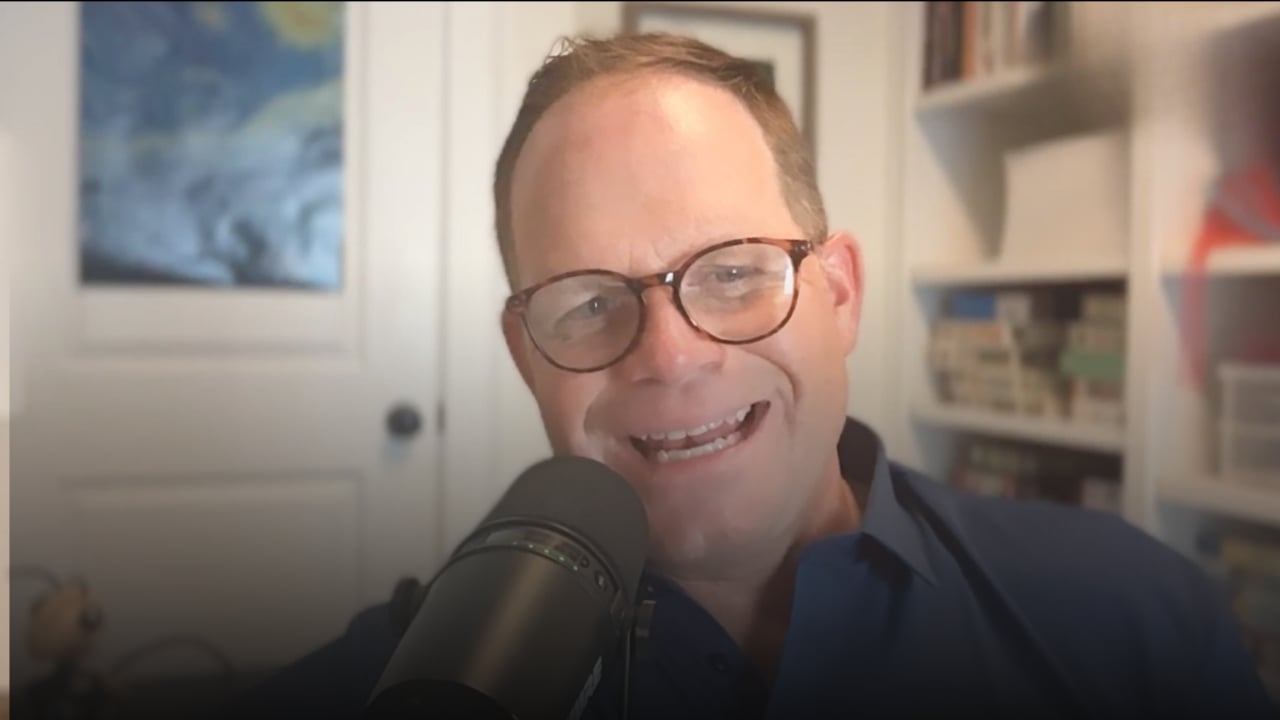
If you’d prefer to listen, you can stream the full episode here or watch the video version here. For accessibility, we’ve included the full transcript below for anyone who prefers to read along or who is hearing impaired.
Justin Landis: Welcome to The Justin Landis Show, your real estate podcast about having conversations, building relationships, and creating freedom. I'm here today with Clay Scroggins, author, speaker, and a fellow Georgia Tech alum. Clay, thanks for being here.
Clay Scroggins: Glad to be here. Justin, I want to double click on that word freedom. How do we help people on this show find freedom?
Justin Landis: When agents build a relationship based business, where people know them, like them, trust them, and go to them as their real estate agent, that gives them freedom. It makes the business more predictable and more sustainable. Compare that to agents who are always chasing, chasing, chasing. That's not freedom, that's closer to bondage.
Clay Scroggins: Did you chase early on?
Justin Landis: You know it. All right, let's talk about your book, How to Lead When You're Not in Charge. It's sold over half a million copies, and I've personally bought and given away close to a hundred of them. What's the backstory?
Clay Scroggins: You and I went to Georgia Tech together, one thing we have in common. Our GPAs are not one of those things, mine was south of 3.0. I knew quickly I didn't need to be an engineer, so I went to graduate school and studied theology. I'd gotten involved in a church in college and had a hunch that's what I wanted to do with my life. For about 20 years I worked in a multi-site church model, kind of like a franchise, one central organization with multiple locations around Atlanta.
Clay Scroggins: If you're familiar with organizations like retirement communities or Chick-fil-A, where a local director reports to a central office, I relate to that job deeply. On a given day you feel like the boss walking around your own site. But the moment you try to push a new vision or start a new program, you hit pushback from headquarters, from the central org. That's when you realize you have some authority, but not nearly all the authority you think you need.
Clay Scroggins: My instinct in those moments was to throw my hands up and say I can't lead, I don't have the power. That's a myth, but it's incredibly common. When I wrote the book I was writing to pastors specifically, but it turns out these principles are industry agnostic. I speak to sports teams, colleges, companies big and small, and it's always the same challenge. People trying to get someone to do something, and when I ask what's in their way, they say, well, they're not on my team, they don't report to me. So I made it my mission to help people cultivate influence no matter where they sit in an organization. If you can learn that, it creates freedom and opportunities you'd never see coming, because you're no longer limited by the org chart.
Justin Landis: You said something important there, that it's about influence, not authority. Tease that difference out for us.
Clay Scroggins: I use this illustration. When your kids are little and you're at the grocery store, they want to sit in those car shaped carts with the plastic steering wheel. You let them turn it, and for a while they think it's working. Then you need to actually get to the produce section, and they see the candy aisle and start frantically turning the wheel, but the cart keeps going straight.
Clay Scroggins: I had a day at work where I felt exactly like that toddler, looking at my boss like, you told me this wheel worked, but it doesn't. I was stuck in the middle, more bosses than I knew what to do with, plenty of ideas, but I couldn't get things to actually move. I was blaming the wheel, meaning I was blaming title and authority for my lack of progress. I got a few promotions over the years, and the biggest letdown was discovering that even in the better seat, I still couldn't move things the way I expected. That's when I started asking, is there something that actually turns the wheel that isn't authority? And the answer is influence.
Justin Landis: You came up with four things that build influence. The first is leading yourself. How does someone do that well, no matter where they sit on the ladder?
Clay Scroggins: I'd encourage anyone listening to build their own list, this is just what I landed on for myself. The first is leading yourself. Most people, myself included at times, will blame someone else for why they can't lead more. Blame is the best way we smuggle our own problems into the future. If you redirect that energy into leading yourself well, it becomes evidence. There's a quote I love: nothing so conclusively proves your ability to lead others as what you do day to day to lead yourself.
Justin Landis: A lot of real estate agents deal with constant rejection and work totally on their own, with no one holding them accountable. What's your advice for leading themselves well through that?
Clay Scroggins: I'll give you the advice you gave me, actually. I quit my job in 2021 to become a corporate speaker, and about a year in I was struggling with the emotional swings of getting booked versus not getting booked. You told me this is exactly what real estate agents deal with constantly, and the fix is to think process instead of outcome. Tie your emotional fulfillment to whether you did the things you can control. Booking a speaking engagement is a lag goal. Did I make ten calls today, did I reach out to ten past clients, did I create something valuable to send to people I know, those are the lead measures. Everything in us wants to tie our emotions to the outcome, but that's not sustainable. Tie it to the process instead.
Justin Landis: That connects to your second point, choosing positivity.
Clay Scroggins: Right, and I chose that word deliberately, because it is a choice. You have to decide to believe something is possible. I had a friend read an early draft of that chapter and tell me it felt like bubble gum, too soft, not enough weight. He wasn't wrong that it can sound like an infomercial. But traveling the world, you see people with far less than we have choosing a better attitude than people who have it much easier. It really is possible. You see it in sports too, a team down but not out, somebody in the locker room refusing to accept the story that it's over. Those people cultivate influence. The question is whether you can convince yourself your attitude actually affects outcomes, not just your mood.
Justin Landis: I've got a personal story on this. Early in my marriage I was naturally more critical and skeptical, and I was complaining a lot. My wife finally told me to lay on the floor, wallow in self pity, and complain for five minutes straight, and then stop, no more complaining after that. It was the start of a real shift for me. I realized being negative wasn't helping me or anyone around me, and it definitely wasn't building influence. I made a decision to choose positivity, and now if you asked my team, most of them would say I'm one of the most positive people they know. But that came from a choice, not something I was born with.
Clay Scroggins: That's exactly it. A cousin of mine was trying to shift his mindset in a town that's notoriously hard to break into socially unless you're from there. I asked if that ever got in his way, and he said, why would I think that way? He decided not to let that belief in, so he goes into every relationship assuming people want to be his friend. If someone's closed off, he assumes something else is going on in their life, not that the town itself is against him. Real estate agents do this to themselves constantly. Why would they work with me, they probably already have someone. That story isn't helpful, and it's usually not even true.
Clay Scroggins: Now, people who are analytical sometimes hear this and think it sounds like toxic positivity. That's where the third behavior comes in, thinking critically, which is different from being critical. Combine the ability to see what needs to change with a posture of positivity, and you get a genuinely powerful leader.
Justin Landis: What's the actual difference between thinking critically and being critical?
Clay Scroggins: Being critical is like the relative at Thanksgiving who always has a complaint, the turkey's dry, here we go again. It's easy to slide into, and it can even feel good in a meeting when you point out a flaw and everyone nods. But identifying an issue alone doesn't make you a leader. People thinking critically are trying to build something, people being critical are trying to tear something down. The real difference underneath it is whether you care about the person or the outcome. When someone criticizes me and I know they genuinely want the best for me, I can actually receive it and change. When it doesn't feel like that, I shut down.
Justin Landis: That reminds me of my longtime business partner, Ashton Ernst, who sells more houses than almost anyone. People assume she's driven by numbers, but she's driven to serve people. I once asked one of her assistants what surprised her most about working with Ashton, and she said it was how far Ashton goes to actually solve problems for clients, problems most agents wouldn't even attempt to fix. That's critical thinking in service of the client, not criticism for its own sake.
Clay Scroggins: I love that. I have a friend with a property management business who built it almost entirely off one client who ended up buying ten more properties after one specific moment of trust. A tenant had an important meeting and a construction crew was making noise next door. My friend told the tenant to have the crew call her directly, then walked over and offered every guy on the crew fifty dollars each to stop working for the day. They did. The owner found out that's how she solved it and became a client for life, and referred ten more properties. That took creativity, but it also took genuine care.
Justin Landis: Take us through the fourth one.
Clay Scroggins: The fourth is rejecting passivity, and this one is something you have to actively avoid, not build. When you're not in charge, it's easy to feel out of control and just wait. Realtors actually have more built in control than a lot of people stuck in the middle of a big organization, you can schedule your own open house, set your own client meetings. But if you want influence, you cannot get passive, because passive people don't cultivate it. Rarely does anything good happen from just passively bumping into it. It happens when you intentionally pursue it.
Justin Landis: Where do agents specifically tend to go passive?
Clay Scroggins: Rarely with an actual client in front of them, most agents genuinely want to serve. Where I see it is in building new business, growing the network, following up with people outside the current client list. That comes back to bite you later because you run out of new clients to serve. It doesn't shrink your influence with current clients, but it shrinks your total influence over time.
Clay Scroggins: I give people three questions to reject passivity. First, what's creating anxiety for your boss, or if you don't have one, what creates the most anxiety in your business. Second, what's the most frequently repeated unsolved problem on your team. Third, the magic wand question, if you could wave a wand and change one thing, what would it be. I was speaking at a medical school faculty event once and a professor told me he hated the magic wand question because it made him furious at his administration for never building a mentor program. I asked what he could actually do about it, and the obvious answer was, he could just go mentor someone himself. He didn't need a program to do that.
Justin Landis: I ask that magic wand question constantly when I first meet agents, to figure out their biggest challenge. It makes people stop and think, and often once they say it out loud they can tell whether it's something they can solve themselves or something I might be able to help with.
Clay Scroggins: That's exactly the mechanism. I remember visiting Facebook's headquarters once and seeing a sign at the front desk that said nothing at Facebook is someone else's problem. That mindset, that an issue for anyone is an issue for everyone, creates influence anywhere you take it.
Justin Landis: To pull it together, what practical next step would you give an agent who wants more influence but doesn't have authority over their clients?
Clay Scroggins: Quick story first. When I was 21 I took an internship at the state capitol for an easy grade, and I got to sit right outside the room where the governor's staff made big budget and policy decisions. One day I overheard a shouting match, and the governor banged the table and said, I am the governor of the state of Georgia, you will listen to me. I call that the weapon of authority. It works in the short term, but nobody wants to work for someone who leads that way long term.
Clay Scroggins: No matter how long you've been an agent, you're going to have more responsibility down the road, more clients, a bigger brokerage, maybe more formal authority eventually. How you leverage your role now determines how well you'll leverage it later. That governor probably had chances to cultivate influence before he had the title and missed them, assuming the seat itself would give him the power. It doesn't work that way. If you learn to lead well without authority now, you'll be a much better leader when you finally have it, and you won't be tempted to reach for the weapon of authority instead.
Justin Landis: Man, I love that. Thank you for sharing that, Clay. For anyone who wants to bring you in to speak, or wants the book, how can people connect with you?
Clay Scroggins: Easiest way is email, [email protected]. You can also text me directly, or find me at clayscroggins.com, I send out a weekly newsletter with leadership content. I'd also love to connect on LinkedIn. Getting to connect with people is genuinely my favorite part of this work.
Justin Landis: Thank you for being here today, Clay. This is going to help agents lead themselves better, lead their clients better, and ultimately find more freedom in their business, which is exactly where we started this conversation.
Justin Landis: All right, everybody, thanks for listening today. Make sure to like and subscribe so you don't miss a single episode, and we'll see you again next week.