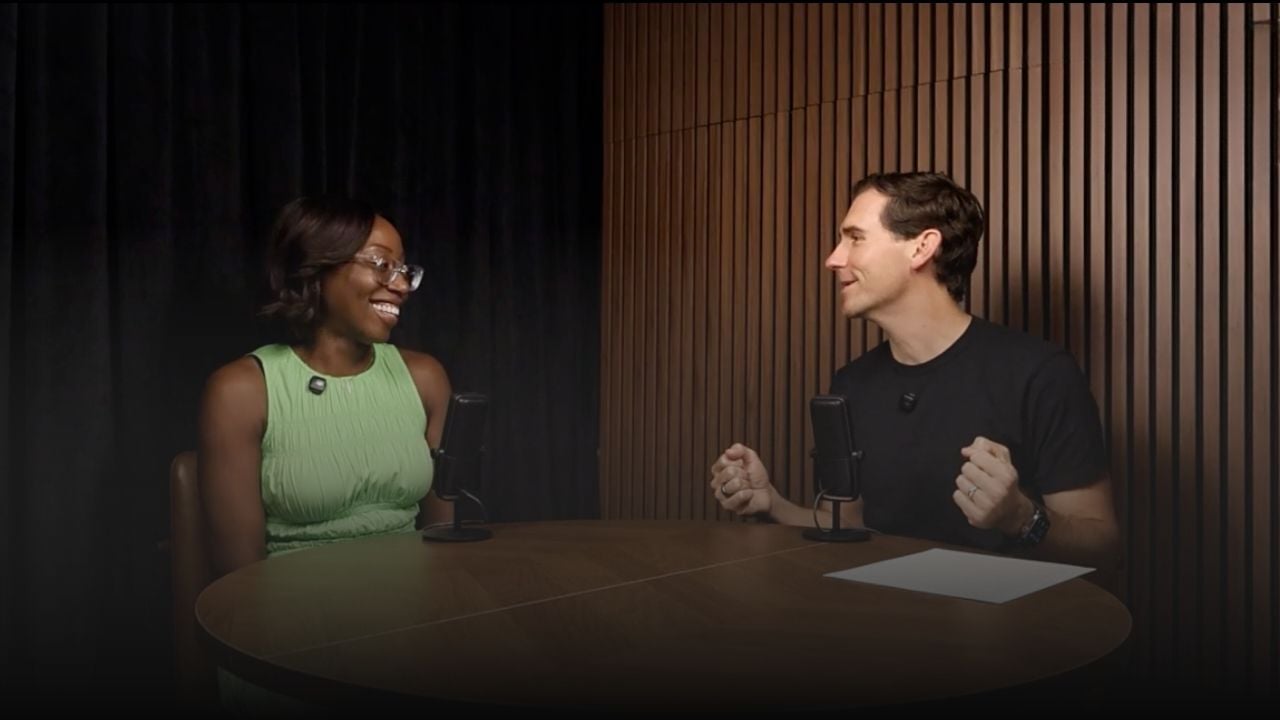
If you’d prefer to listen, you can stream the full episode here or watch the video version here. For accessibility, we’ve included the full transcript below for anyone who prefers to read along or who is hearing impaired.
Jeff Shinabarger: I think the perception with like Netflix shows is that real estate is only about money. Like that it's all about just making more money and selling more houses and throwing a party and popping bottles of champagne or something. Since I've been here, one thing I've realized is like if you're drawn to this idea of purpose in your life and it overlaps with real estate, you want to be a part of something more. There is a community of people that are approaching real estate in a different way. And it might be a really good place to find that purpose, to find that engagement on this team. Because I don't think I haven't seen that. It's not like a cultural thing in real estate where you can't find it ever. You can find that here. And you've done that. You have built that culture that I think more people should feel the invitation to be a part of.
Justin Landis: Welcome to The Justin Landis Show, your real estate podcast about having conversations, building relationships, and creating freedom. Today, I'm here with Jeff Shinabarger. Jeff, thanks for being here today.
Jeff Shinabarger: It's so good to be here.
Justin Landis: Jeff, not everyone may know your story, though a lot of people do, but you spent almost two decades building and running an organization that helped people with social entrepreneurship. Tell us about Plywood People and what that journey was like.
Jeff Shinabarger: Yeah, I mean, the great thing about my story is it's not done. I mean, that's the thing that keeps me going, I think. But yes, I started an organization 17 years ago called Plywood People. And Plywood is a nonprofit in Atlanta that was leading a community of startups doing good. Worked with nonprofits and for-profits over the course of 17 years. We hosted some of the biggest events in the Southeast for those people. We trained over 1,300 different leaders. I got to write some books. But more than anything, I mean, I think my favorite part of that work was, we used to joke, my assistant and I, we used to joke like, I had a couch in my office and people would come and meet me on that couch, at their highest, like the most celebrated moments where I got to launch books with them, launch projects, celebrate and high five and hug and all that stuff, or times they were crying, you know, like where real projects didn't work, you know, they gave all their life into something and they had to end it. So yeah, so I've gotten to be a part of a lot of really unique work in that time.
Justin Landis: Man, what was some of, as you think about those highs and lows, what are some of the favorite highs and lows that you recall?
Jeff Shinabarger: Yeah, there's a guy named Brad Montague who I met very early in his career and in my career. Brad came to a retreat of ours. He was trying to launch this thing where he was giving socks to people that were unhoused in his community. And I had this kind of confrontation with him like, I don't think this is a creative idea, but I don't think it's the thing. It's not the thing for you. It's not like the end all thing. And he left the retreat. He was really mad at me. He tried to drive seven hours later. And about two months later, he sent me a link to this YouTube video. And he said, Jeff, I think I found it. And it was the first video for a massive YouTube channel called Kid President. And he still, for about two years, he still wasn't happy with me, but we became great friends. He always jokes about like, you pushed me. And I think that was what I always felt like my role was, is how do I stand there and see something within a person that they might not see in themselves and try to draw that out.
Justin Landis: Man, what a gift and what an impact with that. So but after 17 years you decided to change directions. You stepped away and you also went for a walk, a long walk, the Camino de Santiago. What did you learn in this season as you kind of stepped away to figure out what your next step was?
Jeff Shinabarger: Yeah, the Camino is this beautiful trail that is historical and it's monotonous. I mean, literally you just walk and walk and walk and walk from city to city.
Justin Landis: How much? How much are you walking?
Jeff Shinabarger: I mean, I walked for 13 days, 17 to 20 miles a day.
Justin Landis: That's a lot of walking.
Jeff Shinabarger: Yeah, exhausting. My ankles were swollen. So what did I learn from that? Yeah, I think I'm still processing part of a year later. But in that time, I was trying to kind of let go of this purposeful work I had given my whole life to and also be open to what might be next. And I think I learned that my whole identity doesn't have to be tied to the one work that I've done so far. Like there's still more for me. Sometimes I would turn a corner and I'd been walking two hours and all of a sudden I see a city. I'm like, oh, I made it to the next city. You know, you don't know what moment that gives you clarity will happen just around the next corner. And that was something really special for me.
Justin Landis: You talked about purpose there. You talk a lot about purpose. And also as we think about like, as you're kind of searching there, a lot of people are searching for like, what is my purpose? How do you help people figure out what their purpose is or how can someone go about figuring that out?
Jeff Shinabarger: Yeah, people ask why do I exist in this world. And that's it, we're getting the big questions here. My wife and I talk about like, it's hard to find someone you love. It's also hard, that's like a whole journey. It's also hard to find why you exist in the world. Like those are two of the biggest questions in life. I think it's easier for us to say what we know we don't want to do oftentimes than it is to give clarity on what we think we ought to do or be or pursue. So I was in Nicaragua one time and was on a bike ride and we were passing this kid on the side of the road and he had this piece of plywood on the, like just above the floor on top of a paint can and an arrow pointed up and it said $1. I'm like, okay, what do we get for $1? So I stopped, was intrigued by it, gave the kid a dollar. He climbs this palm tree or coconut tree and comes down with a coconut. He puts it on the table and he has this machete. He just starts hacking away at the coconut. He sticks a straw in it, hands it to me. I'm like, okay, that's what I get for a dollar. And I started realizing, you know, a coconut, the purpose of that coconut is not to be in the tree. The purpose is to have it to shave off these things all the way around it, to get to the inside, the core, the sweetness, the milk. And this is like deep down inside of us. We have a reason to exist, but we have to shave off the things that we know we aren't supposed to do to get closer and closer and closer to what we ought to be doing. And so that's kind of the best way I can explain it. Start with getting rid of the things you know you're not supposed to be doing, that you don't find joy in, that you don't find life in. Stop doing it. Don't waste your time. Shave those things off. Move forward in some way.
Justin Landis: Man, I really love that. And I don't think a lot of people give a similar answer to that. I think there's a lot of wisdom in that answer. So I love that. Thanks for sharing that. You also, so we've got purpose. Another thing that you are really big on is generosity. I mean, even like excessive generosity. And so tell everybody a little bit like, what does that term excessive generosity mean? How can we be more generous?
Jeff Shinabarger: Yeah, I've done all these social experiments in my life and it turned into a book related to it. But really the first project we did was this realization that I had more than I thought I had. So like you go into the kitchen, you open the refrigerator door and you think there's nothing to eat, right? There's nothing to eat. We've all said that. But so my wife and I challenged each other. We're like, well, how much actually do we have to eat one time? So we said, I wonder how long we could go without having to go grocery shopping. Now, there were some things we decided on the social experiment. We said we could get milk. We could get eggs. There's a couple like baseline things that helped us. But then we started working through the freezer. Like the freezer has all these frozen meats and frozen, like it's like for some reason we kept finding frozen fruit for smoothies. We started putting things together and mashing things together. You start finding all these like canned soups that you didn't realize you've been sitting on. We lasted seven weeks.
Justin Landis: Are you serious? This is just the two of you. In the house? Well, we had seven. And we don't have a pantry. We have just shelves. And it was like, this is, now there were sometimes we ate out like whatever, but it was wild. Now those last couple of weeks, like we ate pancakes three times, you know, like that pancake mix is in there. You have three things of syrup that you bought on multiple trips. But it was a powerful concept because we think we don't have enough. But actually, oftentimes, especially those in our middle class modern world, we have more than we think we have. And so what does it look like when we start asking, what does it look like to live excessively out of the things we already have and start to give to others? And so as you started to look at that, what are some things that people can do or how can we figure out what it is that we can do?
Jeff Shinabarger: Yeah, there's so many little things that are in our lives, like gift cards that everyone has in their personal wallet that has 17 cents or $3.40. So start giving that to people that could use it. Or thinking about food and just going through the practice of clearing out some things and giving it to a local food shelter. Or going to your closet. I did this just to say, like in 15 minutes, you can fill probably three bags of clothes that you don't even use anymore. So I think the practice of that makes you realize how much you've been given and how much you can give to others.
Justin Landis: I have a fun, similar story to your food. I did a month of no spending one time. I actually did this to save up for my wife's wedding ring, but it was also a good social experiment. I was like, this month I'm not going to spend any money except on absolute necessities. And the thing was, the month was a blast. I mean, there was a little bit of inconvenience. I recall going to someone's birthday party and I was eating a peanut butter and jelly sandwich and apple in the car on the way to a fancy dinner. And I sat at this dinner and drank water the whole time. But it was one of those things, was like, man, I spent so much less money that month. I had a great month. There's a lot of things that cost no money that are freely given to us and awesome. And like the follow up for me would be, what if we could take that mentality and not just go with less, but what if we could give to others more?
Jeff Shinabarger: This is amazing. Around Christmas this year, I just challenged myself to give something to someone every day. And I was at this little festival with some friends and I was like, hey, anybody want coffee? I bought coffee for six people. It cost me, whatever, $40. It wasn't like rocket science. They could not believe that I paid for their coffee. It was just like mind-blowing to them. And it's like, what if we've lost that art, that art of giving, the art of generosity? Because in community, we need each other.
Justin Landis: Give it like one or two practical ways. If someone who's listening right now, this is resonating and they're like, I don't know what to do to start being generous. What are a couple examples of things people could do right now, as soon as they stop listening to this, to start being more generous?
Jeff Shinabarger: Yeah, I mean, baseline, it's like, you may have five bottles of wine at your house. Just go give one to your neighbor. See if that creates a conversation. You take it over to them, they're going to be like, well, are we going to drink it together? That's what they're going to say. And then all of a sudden, you go deeper with someone that is literally right next to the place you live. Or maybe the next time you're at a coffee shop, you held the door for someone walking in, and what if you just offered to get their coffee for them? See what happens. It'll blow their minds and it'll make you feel really good. Because those things are so not the norm. It's so awesome when they happen, like completely memorable and awesome. And more so it makes connection with the human. And I think in our age and time right now, everything is getting to be automated, more fast, less human interaction. And if you can find a way any way to connect with another human, it will make your day better because we've forgotten how to do this. And you're going to make their day better.
Justin Landis: Hey, this is Justin with a market update. There is more uncertainty than ever in today's market. And because of that, intentionality means more than it has ever meant. So if you are looking for a team that has structure and systems and processes in place that are proven and tried, I ask you to book a mentor call with me. We can talk about the Justin Landis group and whether that might be the structure, the systems, and the mentorship that you need to take your business to the next level. Back to the podcast.
Justin Landis: Speaking of human interaction, another thing that you spent a lot of time on, including a podcast, was on love and work. And so talking about the tension between staying in love, doing great work, raising your family. Tell everybody a little bit about that journey of love and work and kind of what you learned from that.
Jeff Shinabarger: Yeah, for six years, my wife and I, every Friday, we were doing a podcast like this, which is amazing. It's the work I'm most grateful for. Because I got to do it with her. We got to meet so many people and hear so many amazing stories of real life. Like Andre, my wife's name is Andre. She's a physician's assistant. She works at Grady hospital and has incredible work that she does. And I've done this kind of nonprofit social impact work for all this time. Both of us think our purpose is most important. And when it really comes down to it, a kid gets sick at school. Both of us are busy and you get the call from school. It's like, who's going to go pick up the kid, you know? And so we had to figure that out. And the truth is, we really believe in each other. We want the best for one another. And so we explored this question to the nth degree.
Justin Landis: Can you talk a little bit about that in the context of real estate then? Because the real estate agent, it's not a normal job. I mean, there's times you're super busy, times you may not be. Nights, weekends, there's like not the structure to it. And I have definitely seen that it can be a challenge for partners. What, as you think about what you learned from love and work, what would you say to some real estate agents who are listening about that?
Jeff Shinabarger: Yeah, a couple of things. First, less than 30% of the people that we interviewed over the course of thousands of people, less than 30% of the people we interviewed believe that their partner is in support of their purpose. It was sad. But whether real estate is your purpose, your work, whatever, I think the first thing is coming to an agreement to say, this is what you're doing and I am in support of you. Because it's hard. Real estate agents are working nights and weekends, which means if you have a family, it's going to be very, very challenging. So they have to believe that their partner is behind them in some way. Now, the partner is going to say, if you work every evening and every weekend, and you're never with our kids and you're never with me, then that doesn't work either. So you kind of have to create some boundaries in that. The second thing I would say is every season of your life, you're going to change. There's going to be a season when you're just getting started in real estate and it's hard. And then there'll be a category when you're crushing it. But then you'll go back to a hard season. So identifying the different versions and seasons of you and your life and your partner and understanding how to interact with each other. Those are the two things we learned the most about.
Justin Landis: Wow. I think those are hugely helpful. Especially real estate agents. Man, that's really, really awesome. And it's been awesome to have you in real estate because you recently came on as the fractional chief purpose officer at Bolst. And so it has been awesome having you here. What has it been like making this transition into real estate and being around real estate agents for the first time?
Jeff Shinabarger: Well, I know absolutely nothing about real estate. I got no advice about real estate. I own a house. It's been the best investment I've put any money into. But I think what I have learned is the breadth of people that do real estate is very unique. There's so many different types of people. And my role in it has been, how do I get all of these agents with Bolst to be more generous and to create kind of this framework of purpose for Bolst? Because it's different. I don't know anyone else is doing what Bolst is doing. Be a certified corporation that's committed to giving at least $100 for every sale of a house to the unhoused in our community. And that's what I get excited about.
Justin Landis: And it's been so awesome having you. I was telling somebody about working with you recently. And I said, he can take this amount of information, somehow distill it down really quickly and provide a level of clarity that is just like eye-opening and really challenging. You've done a lot to help us with the clarity. What's that kind of been like? And how do you help people find clarity in what they're doing?
Jeff Shinabarger: I mean, I think if you're a real estate agent listening to this, I know nothing about real estate. I want to be crystal clear. I cannot advise you about being an agent. But I know this. Your first houses that you sold, you were not an expert, right? Every time you go through another one, you start seeing things that you didn't know before because you have these past experiences, these stories, these experiences. So for me, I've just seen a lot of projects. I have seen a lot of things work and a lot more things not work. So I can take a lot of information and see examples from other parts of other stories that I can apply to this information. And we're specifically helping the unhoused.
Justin Landis: And so we've already been able to make some great impacts together. Tell a little bit about kind of the service opportunities and some of the impact that we've been able to make since we've started working together.
Jeff Shinabarger: Yeah, I mean, I think at Bolst, there's a framing and a culture that says we want to give back. Every single agent that I've met, it's a very unique aspect of the culture. They care. And so we've tried to really simplify how they can engage people in the community. So we have these kind of quarterly service projects. We just got done with about 60 people served over the course of three days in partners within the community. And we'll do that a couple more times this year. We have some agents that say, hey, for every house we sell, we'll give this amount of money to this fund. And so that fund, last December, we were able to give about $120,000 away that turned into matching gifts for Giving Tuesday, which that doubled again. And so we're trying to find ways to serve and to give in the community and have a very laser focus on supporting the unhoused.
Justin Landis: Why do you think that laser focus is so important?
Jeff Shinabarger: Because the minute it gets beyond that, it gets confusing to everybody. Same thing with every, you know, if you're an agent and you're trying to advise a client, you need to have laser focus on what the problems are, what the things are you need to address, get it done, move on. In this scenario, the more clarity we have, the more the agents are like, I want to get involved in that. The same thing. Hopefully their clients someday are going to be like, I want to get involved in that work because I bought this house. I'm doing this incredible thing in my community. So we're trying to stay extremely laser focused. We have incredibly generous agents and people on the staff and in this team. And I think it's just like we've only done a fraction of what we can do.
Justin Landis: All right. For someone listening to this who, you know, they want their career to mean something and they don't know where to start. What practical steps could they take?
Jeff Shinabarger: Well, specifically in the real estate agency world, I'll tell you this. I think the perception with like Netflix shows is that real estate is only about money. Like that it's all about just making more money and selling more houses and throwing a party and popping bottles of champagne or something. But since I've been here, one thing I've realized is like if you're drawn to this idea of purpose in your life and it overlaps with real estate, you want to be a part of something more. There is a community of people that are approaching real estate in a different way. And it might be a really good place to find that purpose, to find that engagement on this team. Because I haven't seen that. It's not like a cultural thing in real estate where you can't find it ever. You can find that here. And you've done that. You have built that culture that I think more people should feel the invitation to be a part of.
Justin Landis: Yeah, when we started Bolst, I mean, it was built on the belief that purpose-based business is good business. And I love helping people find their business in their real estate agent business. But I've also seen that a lot of people, they aren't sure what it is yet. And so I've always been like, hey, while you're finding it, come be a part of our purpose. That has a good chance to open your eyes, expose you to things. You can be a part of doing the stuff that we're doing, and that might help you find your purpose. And along the way, you're making a difference. You're around this community of people. You're making an impact. And so, yeah, I mean, I appreciate your invitation. The invitation goes to anybody listening. If you're a real estate agent and you want to find purpose in your work, that's one of the biggest things we're trying to do at Bolst.
Jeff Shinabarger: I want to say one more thing. Two weeks ago, you and I were serving on this volunteer day. We had 20 people there. We got done with the project earlier than we thought. I told everyone we're going to have Chick-fil-A here in like 40 minutes if you're willing to stay for lunch. This is what happened. Nobody left. They sat in that room and they talked and they shared and they kind of just had camaraderie and laughed and enjoyed the moment. Because I think in the work that most real estate agents do, it's lonely. It is like you are by yourself, serving your clients, trying to get in and you're driving by yourself. You're meeting the person there. You don't interact with other people other than at the final sale. And you're on your own. I think what I experienced in that moment was something greater that people deep down want. People behind them, they want to work together with someone. They want to own their own business, yeah, but like they're lonely. And I think that there's something special happening in this group of real estate agents that's very different.
Justin Landis: Yeah, I can't tell you how many conversations I've had with real estate agents as we talk about their future. They'll tell me something along the lines of, I feel like I'm on an island. I feel like I'm doing this all alone. And Bolst helps solve that problem so that you don't have to be on an island. You don't have to be all alone. Because a lot of real estate agents, they are people persons. The reason they're in this business is they're a people person. They love to be around people, but then you find out, like you said, man, if I'm doing this all by myself, that's tough. It's better to do it together. Jeff, thanks for being here today and for all the wisdom you shared. Thanks for all the great work you've done at Bolst. I'm really excited about this next year and for people to hear this episode.
Jeff Shinabarger: Love it.
Justin Landis: If you'd like to learn more, book a mentor call, and we will see you next week on the podcast.